Free Regulatory Tool
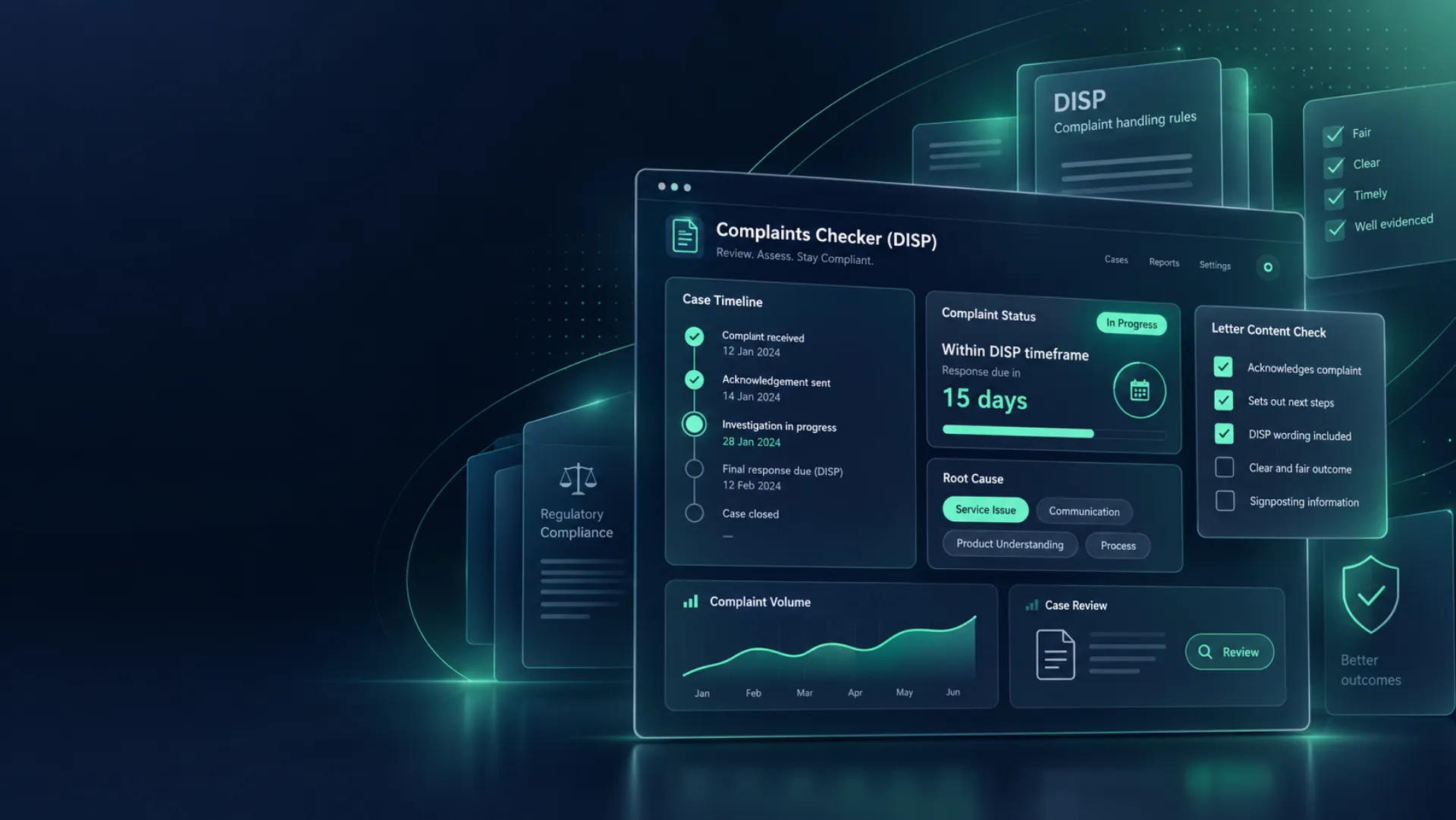
Complaints Checker (DISP)
Stay on track with DISP timelines, mandatory content, and root-cause analysis.
Aligned with DISP 1 (Complaints Handling) and PRIN/Consumer Duty
Why This Tool Exists
Missing DISP deadlines is one of the most common causes of FOS upheld complaints and FCA supervisory action. Firms routinely miscalculate the 8-week deadline, forget to send holding letters, or issue final responses missing mandatory FOS referral rights. This tool eliminates those errors by auto-calculating every deadline and flagging missing content before you send.
How to Use This Tool
Enter the complaint receipt date
Input the date the complaint was received to calculate the final response deadline automatically: 8 weeks for most complaints, or 15 business days for payment services and e-money complaints. It also gives an internal acknowledgement target, because DISP only requires a prompt acknowledgement.
Select the complaint category
Choose the complaint type to receive tailored guidance on root cause analysis, relevant FCA handbook references, and sector-specific requirements.
Review your compliance checklist
The tool generates a personalised checklist covering mandatory letter content, FOS referral rights text, record-keeping requirements, and DISP reporting obligations.
Common Mistakes This Tool Prevents
Sending a final response without FOS referral rights information
How this tool helps: Generates mandatory FOS referral text that must appear in every final response letter
Applying the 8-week clock to payment services and e-money complaints, which have 15 business days
How this tool helps: Uses 8 calendar weeks for most complaints and 15 business days (35 in exceptional circumstances) for PSD and EMD complaints; check bank holidays separately
Not sending a holding letter when the complaint cannot be resolved within 8 weeks
How this tool helps: Flags when a holding letter is required and provides template content
Failing to categorise complaints for root cause analysis and DISP returns
How this tool helps: Prompts categorisation aligned with FCA complaint categories for annual returns
Frequently Asked Questions
What are the FCA complaints handling rules?
The FCA's complaints handling rules sit in DISP 1 (Treating complainants fairly) in the Handbook. They require a firm to have effective and transparent procedures for the reasonable and prompt handling of complaints (DISP 1.3.1R), to acknowledge complaints promptly (DISP 1.6.1R), to send a final response or a written update by the end of eight weeks (DISP 1.6.2R), to identify and remedy recurring or systemic problems (DISP 1.3.3R), to keep records (DISP 1.9.1R) and to report complaints data to the FCA (DISP 1.10).
How long does a firm have to resolve a complaint?
A firm must send a final response by the end of eight weeks after it receives the complaint, or a written response explaining why it cannot and when it expects to (DISP 1.6.2R). A complaint resolved by close of business on the third business day is dealt with through a summary resolution communication instead (DISP 1.5). For complaints about payment services (PSD) and e-money (EMD) the final response is due within 15 business days, extended to 35 business days in exceptional circumstances if a holding response is sent within the first 15 (DISP 1.6.2AR). That rule applies to those complaints, not to every complaint a payments firm receives.
What is DISP in the FCA Handbook?
DISP is the Dispute Resolution: Complaints sourcebook. DISP 1 sets out how firms must handle complaints, DISP 2 sets out the jurisdiction of the Financial Ombudsman Service, and the rest of the sourcebook deals with related complaint handling and Ombudsman matters.
What must a final response letter include?
It must accept the complaint (offering redress or remedial action where appropriate), offer redress without accepting it, or reject it and give reasons. It must also enclose the Financial Ombudsman Service's standard explanatory leaflet, give the Ombudsman's website address, tell the complainant they may now refer the complaint to the Ombudsman, and state whether the firm consents to waive the Ombudsman's time limits (DISP 1.6.2R(1)).
How long does a customer have to go to the Financial Ombudsman Service?
Generally six months from the date of the firm's final response (DISP 2.8.2R(1)). The final response must tell the complainant about this limit. The Ombudsman can still consider a later referral in exceptional circumstances, or where the firm consents to waive the limit.
Do firms have to report complaints to the FCA?
Yes. DISP 1.10 requires firms to send the FCA reports on their complaints data, normally twice a year and within 30 business days of the end of the reporting period (DISP 1.10.1R and 1.10.5R). A small number of firm types report once a year or are exempt. The FCA has said a single unified complaints return, COM001, replaces five existing returns from 1 January 2027, so check the FCA's reporting complaints page for the return that applies to your permissions.
Does the Consumer Duty change how complaints must be handled?
The DISP rules still apply in full. The Consumer Duty adds an outcomes lens: firms must regularly monitor the outcomes their customers get, including from customer support (PRIN 2A.9.8R), and complaints data is one of the most direct sources of evidence a firm has for that monitoring.
Need a Complaints Handling Framework?
Our compliance team can review your existing complaints process, design DISP-compliant procedures, train your staff, and prepare your firm for FOS referrals, so you handle every complaint correctly from day one.
FCA complaints handling: the DISP rules explained
If you are searching for how the FCA expects a regulated firm to handle a complaint, the answer is in DISP 1, the part of the FCA Handbook headed "Treating complainants fairly". This guide sets out the timescales, the procedure a firm must have, what goes in a final response, and how complaints feed into root cause analysis, record keeping, regulatory reporting and the Consumer Duty. The checker above applies the same rules to a specific complaint. For a longer read, see our explainer on DISP complaints handling: what the FCA expects from your firm.
FCA complaint timescales at a glance
| Stage | Time limit | Handbook rule |
|---|---|---|
| Acknowledge the complaint | Promptly, in writing | DISP 1.6.1R |
| Resolve it quickly and send a summary resolution communication | Complaint resolved by close of business on the 3rd business day | DISP 1.5.1R, 1.5.4R |
| Final response (most firms and products) | By the end of 8 weeks, or a written response explaining the delay | DISP 1.6.2R |
| Final response (payment services and e-money complaints) | 15 business days after the day the complaint was received | DISP 1.6.2AR |
| Payment services and e-money, exceptional circumstances | Holding response within 15 business days, final response within 35 business days | DISP 1.6.2AR |
| Customer referral to the Financial Ombudsman Service | Generally within 6 months of the final response | DISP 2.8.2R(1) |
DISP 1.6.1R requires a prompt written acknowledgement, with no fixed number of days. The checker above uses a planning assumption for the acknowledgement date, which is not a DISP deadline. The 15 and 35 business day limits apply to complaints about payment services (PSD) and e-money (EMD) as defined in the Glossary, not to every complaint a payments firm receives.
What DISP is and who it applies to
DISP is the Dispute Resolution: Complaints sourcebook. DISP 1 tells respondents how to deal promptly and fairly with complaints. Respondents include authorised firms carrying on regulated activities, and, for the purposes of the Ombudsman's Compulsory Jurisdiction, certain payment service providers and electronic money issuers that are not authorised firms (DISP 1.1.2 and 1.1.10A to 1.1.10D). DISP 1 protects eligible complainants, who under DISP 2.7.3R include consumers, micro-enterprises, small businesses, and charities and trusts below set size limits. The FCA Glossary definition of "complaint" covers an expression of dissatisfaction, so firms should not wait for the word "complaint".
The complaints procedure a firm must have
A firm must establish, implement and maintain effective and transparent procedures for the reasonable and prompt handling of complaints (DISP 1.3.1R). In practice that means a written procedure that covers:
- how complaints can be made, by any reasonable means (DISP 1.3.2G);
- who logs, investigates and decides, and how a complaint is escalated;
- fair, consistent and prompt assessment of whether to uphold and what redress is appropriate (DISP 1.4.1R);
- the acknowledgement, summary resolution, final response and holding response letters;
- how recurring problems are identified and remedied, and how the board hears about them.
Firms must also publish appropriate information about their internal complaint handling procedures, give it in writing at or immediately after the point of sale, provide it free of charge on request and when acknowledging a complaint, and explain the Financial Ombudsman Service clearly, including its website address (DISP 1.2.1R). The published summary should say how complaints are handled and, where the Ombudsman has jurisdiction, that an unresolved complaint may be referred to it (DISP 1.2.3G). To build your own procedure and log, start from our complaints handling log and procedure template. For deadlines worked out in business days, root cause analysis, a quarterly board report, a helper for the complaints return and response letters with the Financial Ombudsman Service wording, use our free complaints MI and DISP board report pack.
What a final response letter must contain
DISP 1.6.2R(1) says a final response must:
- accept the complaint and, where appropriate, offer redress or remedial action; or offer redress or remedial action without accepting it; or reject the complaint and give reasons;
- enclose a copy of the Financial Ombudsman Service's standard explanatory leaflet and give the Ombudsman's website address;
- tell the complainant they may now refer the complaint to the Financial Ombudsman Service;
- state whether the firm consents to waive the Ombudsman's time limits, using the wording in DISP 1 Annex 3R.
If the firm cannot send a final response within eight weeks, DISP 1.6.2R(2) requires a written response that explains why and when it expects to be able to, tells the complainant they may refer the complaint to the Ombudsman, and carries the same leaflet, website and time limit waiver content. Where a complaint is resolved by close of business on the third business day, the summary resolution communication must say the firm considers the complaint resolved and tell the customer they may be able to go to the Ombudsman if they remain dissatisfied (DISP 1.5.4R). The customer has six months from the final response (or summary resolution communication) to refer a complaint to the Ombudsman (DISP 2.8.2R(1)).
Root cause analysis under DISP 1.3
A firm must take reasonable steps to make sure that, in handling complaints, it identifies and remedies any recurring or systemic problems. That includes analysing the causes of individual complaints to find root causes common to types of complaint (DISP 1.3.3R). The guidance at DISP 1.3.3BG points to collecting management information on complaint causes and keeping records of the analysis and decisions taken by senior personnel. Categorising by product alone is rarely enough. Read our explainer on complaints root cause analysis, and use the complaints root cause analysis workbook to record cause, outcome and trend.
Record keeping for complaints
A firm must keep a record of each complaint and the measures taken to resolve it. The record must be kept for three years from the date the complaint was received, or five years for complaints about UCITS scheme portfolio management and certain EEA UCITS schemes (DISP 1.9.1R). The FCA notes these records can support the management information and regular reporting to senior personnel described in DISP 1.3.3BG (DISP 1.9.2G). Your firm's own record keeping policy may require longer.
Complaints reporting to the FCA
Under DISP 1.10.1R most firms report complaints data to the FCA twice a year, and reports are due within 30 business days of the end of the reporting period (DISP 1.10.5R). Firms with only some permission types, such as limited permission firms, follow different arrangements, and the format depends on the number of complaints the firm received (DISP 1.10.2R). The FCA has announced a single, unified complaints return, COM001, to replace five existing returns from 1 January 2027, with reporting on a fixed six-month and calendar-year basis. Because the return and its data points are changing, confirm what applies to you on the FCA's reporting complaints page before you build your management information.
How the Consumer Duty interacts with complaints handling
The Consumer Duty does not replace DISP. The timescales, letter content and Ombudsman referral rights above all still apply. What the Duty adds is a requirement to monitor outcomes. Under PRIN 2A.9.8R a firm must regularly monitor the outcomes its customers are experiencing from its products, communications and customer support, and PRIN 2A.9.9R includes whether customers receive the support they need. Complaints are one of the clearest signals of poor support or poor outcomes, so well-structured complaints data, split by root cause, product and customer characteristics, is practical evidence for that monitoring and for board reporting. Our explainer on complaints trend analysis and board escalation shows how to turn the data into action.
Rule references checked against the FCA Handbook (DISP 1, DISP 2.8, PRIN 2A.9) and the FCA reporting complaints page. This is general information, not legal advice. Rules change, so check the current Handbook text.
About the Complaints Checker (DISP)
DISP (Dispute Resolution: Complaints) sets out the FCA's requirements for handling complaints fairly and efficiently. Breaching DISP timelines or failing to provide mandatory information can result in FOS referrals, upheld complaints, and regulatory scrutiny.
Key DISP requirements this tool helps you comply with:
- Promptly: Send a written acknowledgement (DISP 1.6.1R)
- 8 weeks: Issue final response (or explain delay and provide FOS referral rights). Payment services and e-money: 15 business days
- Final response content: Decision, reasoning, redress (if applicable), FOS referral information
- Record-keeping: at least 3 years retention (DISP 1.9.1R), root-cause analysis, DISP reporting to FCA
Financial Ombudsman Service (FOS)
If a customer is dissatisfied with your final response, they can refer the complaint to FOS within 6 months. FOS can:
- • Award compensation up to £455,000 for complaints referred from 1 April 2026 about acts on or after 1 April 2019 (the limit is revised each April)
- • Order you to take specific actions (e.g., amend records, apologise)
- • Publish decisions that damage your reputation
- • Refer systemic issues to the FCA for investigation
FOS decisions are binding on firms (but not customers). Refusing to comply can result in FCA enforcement action.
Root Cause Analysis & Learning from Complaints
The Consumer Duty requires firms to act on complaints to drive improvements. You should:
- • Categorise complaints by root cause, not just subject matter
- • Track trends: are complaints increasing in specific areas?
- • Identify systemic issues: repeated complaints may indicate product/process failures
- • Take action: implement changes to prevent recurrence
- • Report to board: senior management must understand complaint drivers and actions
Need Complaints Handling Support?
We can review your complaints processes, prepare responses to FOS, implement root-cause analysis frameworks, and train your complaints handling team.
Book a Free Scoping Call →