MCOB is not one mortgage checklist. It is a set of connected conduct requirements that change with the firm's role and with the stage of the customer journey. The control question for a mortgage intermediary is different from the control question for a lender or an administrator.
The Mortgages and Home Finance: Conduct of Business sourcebook covers the journey from financial promotion and initial disclosure through advice, application, responsible lending, offer, administration and payment difficulty. Firms should map each obligation to the legal entity and team that actually performs the activity.
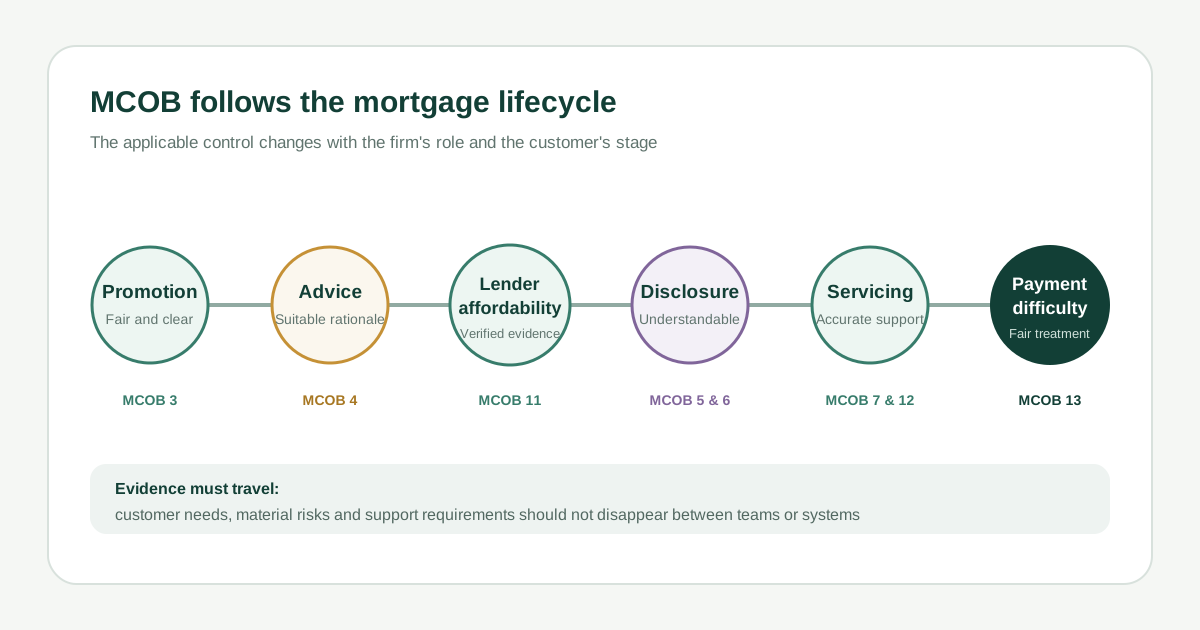
Start with role, product and journey stage
A reliable MCOB framework begins with three facts:
- Is the firm acting as intermediary, adviser, lender, home purchase provider or administrator?
- What regulated mortgage or home finance product is involved?
- Is the customer at promotion, advice, application, offer, servicing or payment-difficulty stage?
This prevents a common governance error: allocating a control to every party because the rule is described broadly as a "mortgage requirement". It also makes oversight more useful. A broker file review should focus on the quality of the recommendation and disclosure, while a lender's review should test responsible-lending evidence and its decision.
MEMA's mortgage broking compliance service is structured around that role-based mapping.
Advice: a recommendation must fit the customer
Under MCOB 4.7A, a firm giving regulated mortgage advice must take reasonable steps to ensure that its personal recommendation is suitable. Suitability is based on the facts disclosed by the customer and other relevant facts of which the firm is or should reasonably be aware.
The file needs to show more than a product match. It should connect the customer's needs and circumstances to the recommended product's material features, such as payment structure, term, rate period, flexibility, fees and relevant risks. Where no product in the firm's range is suitable, the rules do not permit the firm to manufacture a recommendation to complete the sale.
Where the recommended product is not the cheapest appropriate product available in its range, MCOB 4.7A also requires the firm to explain why. The rule is not simply "recommend the cheapest". It requires the file to make the relevant trade-off intelligible.
Records should retain the information about the customer, why the recommendation was suitable and the required fee or cheaper-product explanations. A templated suitability note that repeats the product features without connecting them to the customer does not provide that evidence.
Responsible lending: keep the lender's duty distinct
MCOB 11 applies the responsible-lending framework principally to mortgage lenders and home purchase providers. Before entering into or varying an in-scope contract, the firm must assess whether the customer can pay the sums due and must be able to demonstrate affordability, subject to specific exceptions.
The assessment must take full account of net income, committed expenditure and the household's basic essential and basic quality-of-living costs. For mortgage lenders, it must also account for capital and interest over the term, unless a relevant interest-only provision applies, and the impact of likely future interest-rate increases. The lender cannot base affordability on the property's equity or an expected increase in property value, and cannot rely on a general declaration of affordability.
Income evidence must be adequate for each element used and independent of the customer, although documents supplied by the customer can still be independent evidence. Actual commitments require reasonable enquiry. Statistical or modelled data may be used for certain household expenditure, but the assumptions must be realistic for the composition of the household.
Product transfers and variations require careful scoping. MCOB 11.6.3 provides limited exceptions where, among other conditions, there is no additional borrowing beyond permitted fees and no change likely to be material to affordability. A switch to interest-only, an extension into retirement or adding or removing a customer may be material. Firms should record why an exception applies rather than labelling every same-lender change "like for like".
Disclosure: test understanding, not document dispatch
MCOB 5 sets pre-application disclosure requirements intended to help customers understand and compare a proposed contract. MCOB 6 covers disclosure at offer stage.
Document production is only the first control. The firm should also test whether key costs, conditions and risks are presented consistently across the conversation, recommendation, illustration and offer. Material differences should be explained before the customer is committed.
Consumer Duty does not erase the MCOB rules. It adds an outcomes lens to the way the firm designs and tests the journey. The four Consumer Duty outcomes are therefore relevant to whether communications support understanding, products meet the target market, price and value are assessed and customers can obtain effective support.
Payment difficulty: policy must translate into individual support
MCOB 13.3 requires a firm to have written policies and procedures, approved by its governing body and reviewed periodically, for dealing fairly with customers who have or may have a payment shortfall.
The rules include making reasonable efforts to reach an agreement, allowing reasonable time to consider proposals, providing adequate information about implications and keeping arrangements under review. Firms must also provide prescribed information and signposting at relevant points. The exact requirements and timing should be traced to the current rule for the customer's circumstances.
A good support record should show what the firm knew about the customer's position, the options considered, why the selected arrangement was appropriate, what the customer was told and when the arrangement will be reviewed. It should not merely record that a standard forbearance option was applied.
Charges associated with a payment shortfall are addressed in MCOB 12.4. A charge must be no higher than a reasonable estimate of the cost of the additional administration caused by the shortfall. That makes cost evidence and governance part of the control.
One evidence map for the mortgage lifecycle
| Control area | File-level evidence | Portfolio-level challenge |
|---|---|---|
| Advice | Customer facts, needs, options considered, recommendation and rationale | File-review themes, exceptions, complaints and customer outcomes |
| Responsible lending | Verified income, expenditure, assumptions, stress and decision | Overrides, early payment difficulty, segments and model performance |
| Disclosure | Correct document, timing, explanation of material features and changes | Comprehension testing, errors, journey abandonment and complaints |
| Payment support | Circumstances, contact attempts, options, arrangement and review | Contact effectiveness, repeat difficulty, charges, exits and repossessions |
The board should see where evidence fails to connect across these stages. For example, a customer characteristic identified during advice should not disappear from servicing records. A concentration of early payment difficulty should inform lender-model review and, where relevant, intermediary quality oversight. Complaint root causes should change training, scripts or product governance rather than remaining in a quarterly pack.
A practical review sequence
First, build a role and rule map for each journey. Then reconcile customer-facing documents and system steps to that map. Sample files across advised sales, exceptions, product transfers, vulnerable-customer indicators and payment support. Check whether the record permits an independent reviewer to understand the customer's position, the decision made and the reason for it.
Finally, test management information against actual files. A high pass rate is not persuasive if review criteria examine document presence but not suitability, affordability evidence or customer outcomes. Findings need named owners, due dates and post-implementation testing.
Firms seeking an independent review can use MEMA's mortgage broking compliance support to scope the applicable rules, test files and improve oversight without confusing intermediary and lender responsibilities.
Primary sources checked
- FCA Handbook, MCOB 4: Advising and selling standards
- FCA Handbook, MCOB 5: Pre-application disclosure
- FCA Handbook, MCOB 11: Responsible lending
- FCA Handbook, MCOB 13: Payment difficulties and repossessions
This explainer is general information, not legal advice. The provisions that apply depend on the firm's role, product and facts of the transaction.
Frequently Asked Questions
What does MCOB cover?
MCOB is the FCA sourcebook for mortgages and home finance. Its chapters cover matters including promotions, advising and selling, pre-application and offer disclosure, responsible lending, charges and the treatment of customers in payment difficulty. The provisions that apply depend on the firm's role, product and transaction.
Who is responsible for the MCOB affordability assessment?
MCOB 11 applies the responsible lending assessment principally to mortgage lenders and home purchase providers. An intermediary has separate advice, disclosure and conduct obligations. A broker should not present the lender's MCOB 11 assessment as if it were the broker's own regulatory affordability decision.
Is a full affordability assessment always required for a product transfer?
No. MCOB 11.6.3 contains limited exceptions for certain replacement or varied contracts where there is no additional borrowing beyond permitted fees and no change likely to be material to affordability. The conditions must be checked and documented. Consumer Duty and responsible-lending considerations may still be relevant.
What records support a mortgage recommendation?
For an advised sale, the file should record the relevant customer information and why the recommendation was suitable. MCOB 4.7A also requires records concerning positive choices to pay a fee and, where applicable, why a recommended product was not the cheapest appropriate product in the firm's range.
Need help implementing this?
Our regulatory consultants can help your firm meet FCA requirements with practical, evidence-based implementation support.
Book a Free Consultation