The 4 Consumer Duty outcomes are products and services (PRIN 2A.3), price and value (PRIN 2A.4), consumer understanding (PRIN 2A.5) and consumer support (PRIN 2A.6). They sit beneath Principle 12 and the Duty's three cross-cutting rules in PRIN 2A.2, and each one carries its own FCA rules and evidence expectations, set out below.
| # | Outcome | PRIN 2A reference |
|---|---|---|
| 1 | Products and services | PRIN 2A.3 |
| 2 | Price and value | PRIN 2A.4 |
| 3 | Consumer understanding | PRIN 2A.5 |
| 4 | Consumer support | PRIN 2A.6 |
What the Consumer Duty requires
There are four Consumer Duty outcomes: products and services, price and value, consumer understanding, and consumer support. They sit beneath Principle 12 and the three cross-cutting rules, and each one carries its own FCA expectations and evidence.
The Consumer Duty requires firms to act to deliver good outcomes for retail customers. It is not a checklist or a requirement to guarantee that every customer makes the best possible decision. It is an outcomes-based standard that asks firms to design, distribute, communicate and support retail products in a way that can be evidenced in practice.
The framework has three layers. Principle 12 states the overall standard. Three cross-cutting rules require firms to act in good faith, avoid causing foreseeable harm, and enable and support customers to pursue their financial objectives. The four outcomes then apply that standard to the main parts of the firm-customer relationship.
The current rules are in PRIN 2A of the FCA Handbook. The FCA also maintains a Consumer Duty publications and resources hub, which brings together final guidance and current examples of good and poor practice.
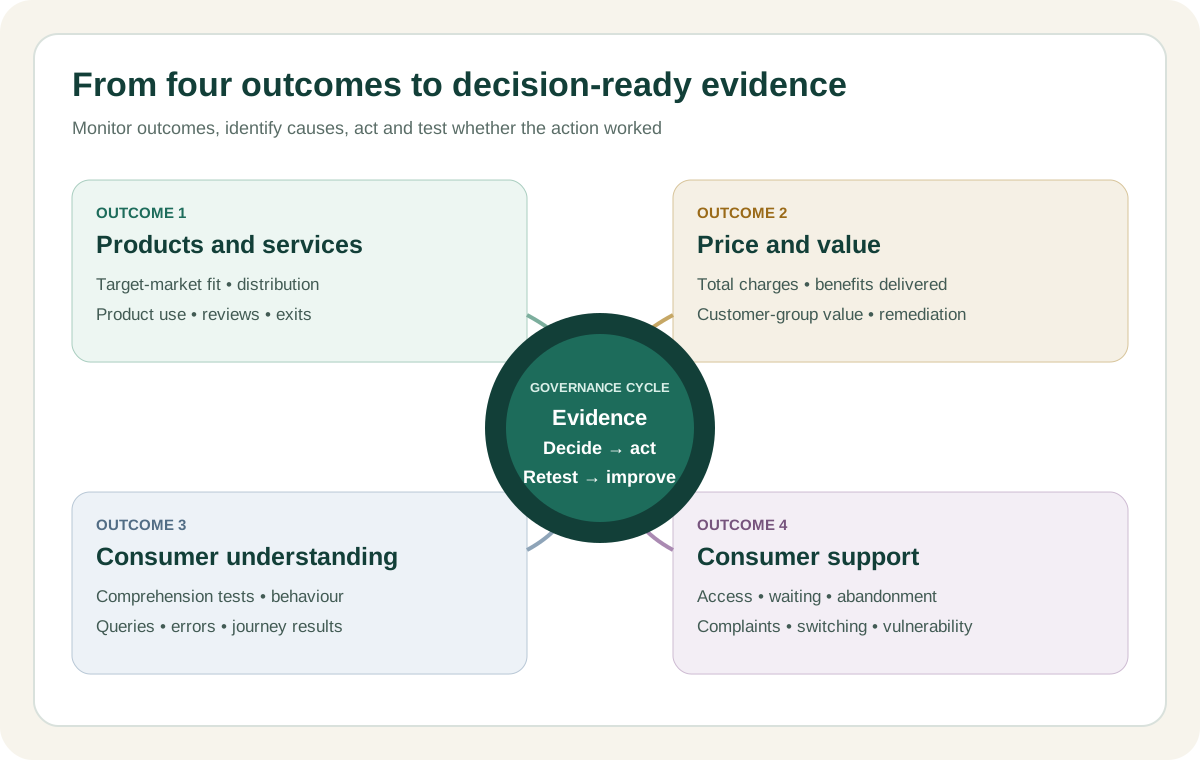
The four outcomes at a glance
| Outcome | PRIN 2A | What the firm must establish | Useful outcome evidence |
|---|---|---|---|
| Products and services | 2A.3 | Products are designed for an identified target market and continue to meet its needs, characteristics and objectives | Target-market analysis, product reviews, distribution data, out-of-market sales and customer-impact findings |
| Price and value | 2A.4 | The total price is reasonable compared with the benefits customers receive | Fair-value assessments, fees and charges, service delivery, product use, customer-group comparisons and remedial decisions |
| Consumer understanding | 2A.5 | Communications support effective, timely and properly informed decisions | Comprehension testing, behavioural data, call analysis, digital-journey results and changes made after testing |
| Consumer support | 2A.6 | Customers can use, change, cancel and obtain help without unreasonable barriers | Waiting times, abandonment, channel access, complaints, cancellation journeys, support outcomes and vulnerability analysis |
The quality test is not whether each process exists. It is whether the evidence allows the firm to identify good and poor outcomes, understand their causes and take appropriate action.
Outcome 1: Products and services
The products and services outcome sits in PRIN 2A.3. A manufacturer must operate an approval process that identifies the target market at a sufficiently granular level and considers the market's needs, characteristics and objectives. Distribution arrangements should be appropriate for that market, and products must be reviewed regularly.
The FCA's July 2026 report on products and services good practice provides a useful current benchmark. The FCA saw firms mapping customer needs to product design, using customer-impact assessments and adapting journeys for different customer groups. It also found target markets that were too generic, monitoring that relied too heavily on complaints, and changes whose effect on customer outcomes was never validated.
That distinction matters. A product committee may approve a document without knowing whether the product reaches the intended customers or works for them. Stronger evidence connects the target-market definition to actual distribution, use, complaints, early exits and customer feedback. Where an intervention is made, the firm should subsequently test whether it improved outcomes.
Some products remain subject to specific rules in PROD. The FCA explains that where PROD 3, PROD 4 or PROD 7 applies, those rules continue to govern the relevant product-governance requirements. Firms should therefore map the Consumer Duty and sector rules together rather than duplicating or replacing established product governance without analysis.
Outcome 2: Price and value
The price and value outcome is in PRIN 2A.4. The question is whether the total price paid by the customer is reasonable compared with the nature, quality and benefits of the product or service. Being cheaper than a competitor does not, by itself, establish fair value.
A useful fair-value assessment explains the product, target market, expected benefits, limitations and total customer cost. It then examines whether particular customer groups receive different value. That may require looking beyond the headline fee to distribution charges, commissions, add-ons and whether an ongoing service is actually delivered.
The conclusion should be capable of challenge. If the analysis finds poor value, the assessment needs an action, accountable owner and follow-up measure. Possible responses may include changing the price, improving the service, altering the target market, compensating affected customers or withdrawing the product. The appropriate response depends on the evidence and the firm's role.
The FCA's Consumer Duty resources include sector reviews and price-and-value examples. These publications are supervisory learning, not a substitute for the rules or a universal template. Their value lies in showing the kind of analysis the FCA regards as outcome-focused.
Outcome 3: Consumer understanding
The consumer understanding outcome is in PRIN 2A.5. Firms should support customers to make effective, timely and properly informed decisions. Communications must be considered in context: the audience, complexity, timing, channel and decision all affect whether the communication works.
In March 2026, the FCA published good practice and areas for improvement on consumer understanding. It emphasised management information and testing, communications design, vulnerability and accessibility, financial promotions, and governance. The examples do not create new requirements and the FCA does not expect every firm to adopt every example.
For a firm, the practical question is what it knows after a communication has been sent. Delivery and open rates show reach, but they do not establish comprehension. Better evidence can include customer testing, error rates, repeated queries, abandoned journeys, unexpected choices, complaints, call listening and post-communication behaviour. The method should be proportionate to the audience and risk.
Testing also needs a feedback loop. If customers misunderstand a key feature, the firm should change the communication or journey and then test again. A readability score can support this work, but it cannot replace evidence about whether the intended customers understood what mattered.
Outcome 4: Consumer support
The consumer support outcome is in PRIN 2A.6. Support should enable customers to use their product, pursue their financial objectives and act in their interests. Firms should avoid unreasonable barriers when customers seek help, switch, cancel, complain or make a claim.
The evidence should compare the complete customer journey. A sales channel that works in minutes alongside a cancellation process that requires repeated calls may reveal friction that is difficult to justify. Aggregate service-level data may also conceal poor outcomes for a particular channel or customer group.
Relevant measures can include time to answer, abandonment, repeat contact, unresolved cases, complaint causes, cancellation completion, claims outcomes and the availability of alternative channels. Firms should also examine outcomes for customers in vulnerable circumstances rather than assuming that the average result applies to everyone.
The FCA's March 2025 review of outcomes for customers in vulnerable circumstances provides examples on governance, monitoring and support. It should be read alongside FG21/1 and the current Consumer Duty rules.
What firms should monitor
PRIN 2A.9 requires firms to monitor regularly the outcomes retail customers receive from products, communications and support. Firms that lack direct customer contact should act reasonably to obtain information about customer outcomes relevant to their role.
An effective monitoring framework combines several types of evidence. Operational data shows what happened. Customer and staff feedback adds context. Complaints and root-cause analysis reveal recurring problems. Behavioural data can show misunderstanding or friction. Comparisons across products, channels and customer groups help identify pockets of harm that an overall average would hide.
Monitoring should lead to decisions. The FCA's 2026 products-and-services review found that some firms collected metrics but did not use them to trigger targeted reviews, or made changes without validating the impact. A board pack filled with data but lacking interpretation, ownership and follow-up is therefore weak evidence of compliance.
For a practical monitoring structure, our Consumer Duty board-pack guide explains how to connect outcome measures, root causes, remediation and governance.
The annual governing-body report
PRIN 2A.8 requires a report setting out the results of monitoring and any actions required. At least annually, the governing body must review and approve it, confirm whether it is satisfied that the firm complies with the Duty, and assess whether the future business strategy is consistent with the Duty.
When approving the report, the governing body must also agree action to address identified risks or instances of poor outcomes and any necessary changes to business strategy. This means the report is a decision document, not simply an annual compliance narrative.
In April 2026, the FCA's review of second-year Consumer Duty board reports found stronger governance, clearer action plans and broader data. It also found reports that presented extensive management information without explaining what it demonstrated, and weaker assessment of consumer understanding and support.
A strong report therefore shows the outcome, the evidence, the conclusion, the customer groups affected and the action taken. It should explain limitations and missing data rather than allowing a confident conclusion that the evidence cannot support.
Scope, closed products and the 2026 consultation
The Duty came into force for open products and services on 31 July 2023 and for closed products and services on 31 July 2024. The FCA defines a closed product for this purpose as one held under a contract entered before 31 July 2023 and not marketed or distributed, including by renewal, on or after that date. Its information for firms explains the scope and confirms that the Duty does not apply retrospectively.
On 29 June 2026 the FCA opened CP26/23 on scope and proportionality. The proposals include clarifying where the Duty applies, responsibilities across distribution chains and interaction with other product-governance rules. The consultation closed on 18 September 2026.
CP26/23 is not final policy. Firms should consider it when planning substantial changes but should not describe its proposals as current rules. Existing obligations remain in force unless and until the FCA makes and commences changes.
A practical review sequence
Start with scope and role: which retail products, services and distribution activities are relevant, and what can the firm influence? Define what a good outcome would look like for each target customer group. Map the evidence already available against the four outcomes, including evidence for customers in vulnerable circumstances.
Then test the conclusions. Identify where data is process-based rather than outcome-based, where averages conceal different customer experiences, and where information from distributors or manufacturers is missing. For each material concern, assign an owner, decision and measure of whether the response worked.
Finally, connect the monitoring to governance. The governing body should receive a clear explanation of what the evidence demonstrates, what it does not demonstrate and how the firm's strategy affects future outcomes. That creates a defensible chain from customer experience to management action and board approval.
MEMA's Consumer Duty Outcomes Checker can help structure an initial assessment. For a deeper independent review of monitoring, fair value and board evidence, see our Consumer Duty service or book a consultation.
Frequently Asked Questions
What are the four Consumer Duty outcomes?
The four outcomes cover products and services, price and value, consumer understanding, and consumer support. They sit beneath Principle 12 and the three cross-cutting rules in PRIN 2A.
How often must the Consumer Duty board report be approved?
PRIN 2A requires the governing body to review and approve the report on retail customer outcomes at least annually. Monitoring must continue throughout the year rather than being limited to the annual report.
Does Consumer Duty apply to closed products?
Yes. The Duty came into force for closed products and services on 31 July 2024. A closed product is one held by existing customers under a contract taken out before 31 July 2023 and not marketed or distributed, including by renewal, on or after that date.
Has CP26/23 changed the Consumer Duty rules?
No. CP26/23 is an FCA consultation on scope and proportionality. It opened on 29 June 2026 and closed on 18 September 2026. Firms should distinguish its proposals from the rules currently in force.
Need help implementing this?
Our regulatory consultants can help your firm meet FCA requirements with practical, evidence-based implementation support.
Book a Free Consultation