What It Is
Affordability assessment is the process by which a consumer credit firm determines whether a prospective borrower can sustainably meet repayments without undue difficulty. It sits within the broader creditworthiness obligation in CONC 5.2A of the FCA Handbook, which requires firms to assess both the credit risk (likelihood of default) and the affordability (ability to repay without hardship) of any regulated credit agreement before it is entered into.
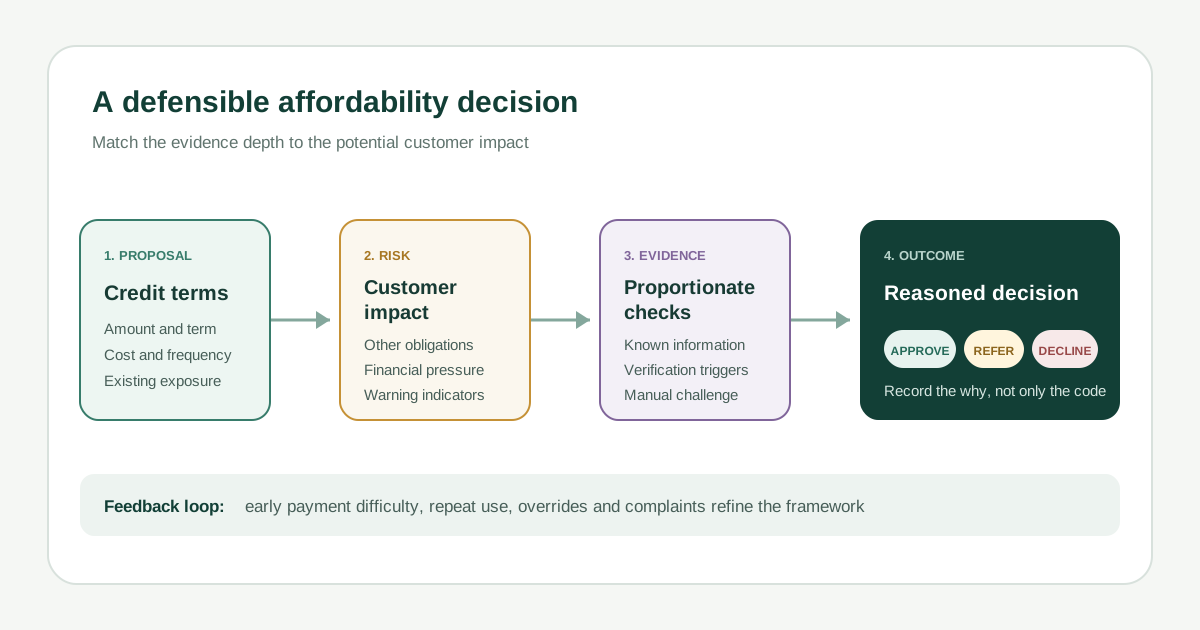
The concept is deceptively simple but operationally complex. An affordability assessment requires the firm to form a reasonable view of the customer's income, committed expenditure, essential living costs, and discretionary spending — then determine whether the proposed repayments can be met from the resulting surplus with an adequate buffer. For short-term credit, the assessment may focus on immediate cashflow. For longer-term agreements — motor finance, personal loans, credit cards — the firm must consider sustainability over the life of the agreement, including foreseeable changes in circumstances.
The FCA's expectations for affordability assessment have evolved significantly since it assumed responsibility for consumer credit regulation in 2014. Early enforcement action focused on payday lenders and high-cost credit, but the scope has expanded steadily. The motor finance commission review, interventions on persistent credit card debt, the overdraft pricing reforms, and the forthcoming regulation of buy-now-pay-later (BNPL) products have all sharpened the regulator's expectations. Today, affordability is the single issue most likely to generate enforcement action, redress requirements, or skilled person appointments under Section 166 in the consumer credit sector.
The framework is not prescriptive about methodology. The FCA does not mandate specific income-to-debt ratios or require particular data sources. Instead, it sets an outcomes-based standard: the assessment must be sufficient, given the nature of the credit and the circumstances of the borrower, to form a reasonable conclusion about sustainable repayment. This flexibility is intentional but it creates uncertainty — and it is in the gap between flexibility and expectation that most firms fall into difficulty.
Why the FCA Cares
Consumer credit is the most widely used financial product in the United Kingdom. The FCA regulates over 40,000 consumer credit firms, and the potential for harm from unaffordable lending is enormous. When a customer takes on credit they cannot afford, the consequences cascade: missed payments, default, county court judgments, difficulty accessing housing or employment, and significant mental health impacts. The FCA's own Financial Lives Survey consistently shows that consumer credit difficulties are among the most common sources of financial distress.
The regulator's focus on affordability sharpened materially after the high-cost credit market review (2017-2019), which revealed that millions of customers were being approved for credit they could not sustainably repay. Payday lenders were rolling over loans without reassessing affordability. Credit card issuers were increasing limits without considering whether customers in persistent debt could ever repay. Guarantor loan firms were approving borrowers whose guarantors were themselves financially stretched. The FCA's response — price caps, lending restrictions, and the persistent debt rules — all stemmed from CONC 5 affordability requirements that firms had systematically failed to meet.
The motor finance sector is now the epicentre of affordability scrutiny. The FCA's review of discretionary commission arrangements found that commission structures incentivised brokers to place customers on higher-rate deals, and that affordability assessments at point of sale were frequently inadequate. The Supreme Court's ruling on secret commissions in motor finance has created potential redress liabilities running into billions of pounds. The FCA's Dear CEO letter to motor finance firms (March 2024) made clear that affordability assessment failures in this sector would be treated as serious regulatory breaches.
BNPL adds a further dimension. As BNPL moves towards full FCA regulation, the regulator has signalled that affordability assessment will be a central requirement. The FCA's concern is aggregation risk: customers accumulating multiple BNPL agreements across providers, none individually large but collectively unsustainable. The FCA expects regulated BNPL firms to assess total exposure, not just the individual transaction, which will require data-sharing mechanisms that do not yet fully exist.
Who It Affects
The affordability obligation applies to every firm that makes a creditworthiness assessment under CONC 5.2A. This encompasses all firms with permission to enter into a regulated credit agreement as lender, including banks, building societies, specialist consumer credit firms, motor finance houses, retail finance providers, fintech lending platforms, and credit unions. It also applies to peer-to-peer lending platforms that facilitate regulated credit agreements.
Credit brokers bear a distinct but related obligation. CONC 5.2A.6R requires brokers to undertake a creditworthiness assessment before introducing a customer to a lender unless the lender will conduct its own assessment. In practice, many brokers — particularly motor dealers and retail finance intermediaries — have relied on the lender's assessment without conducting their own. The FCA has challenged this approach, particularly where the broker's commission structure creates incentives to maximise approval rates rather than assess suitability.
The obligation extends to firms that manage credit agreements post-origination. Where a firm increases a credit limit, offers further borrowing, or restructures an agreement, CONC requires a fresh or updated affordability assessment. Firms that acquire loan portfolios and manage them must also consider ongoing affordability when making decisions about arrears management, forbearance, and collections strategy.
High-cost credit firms — those offering high-cost short-term credit, home-collected credit, catalogue credit, and guarantor loans — face the most intensive requirements. The FCA applies enhanced supervisory scrutiny to these firms and expects affordability assessments to be proportionately more rigorous, reflecting the higher risk profile of their customer base. For these firms, reliance on self-declared income without verification is unlikely to be sufficient.
What Firms Get Wrong
The most fundamental error is conflating credit scoring with affordability assessment. A credit score is a statistical model that predicts default probability based on historical patterns. It says nothing about whether this particular customer can afford this particular product at this particular time. A customer with an excellent credit score may have recently taken on significant new commitments that make further borrowing unaffordable. Conversely, a customer with a thin credit file may have ample disposable income. The FCA has taken enforcement action against multiple firms — including major high-street lenders — for treating a positive credit score as sufficient evidence of affordability.
The second systematic failure is in expenditure assessment. Many firms use statistical models or national averages to estimate customer expenditure rather than assessing actual spending. The FCA's position, articulated clearly in its 2020 consultation on creditworthiness assessment (CP18/43 outcomes), is that statistical models may be acceptable as a starting point but must be supplemented with customer-specific data where the credit is significant relative to income or where there are indicators of financial stress. A firm that applies an ONS average expenditure figure to a customer with three dependants, a mortgage, and existing credit commitments is not conducting a reasonable assessment.
Third, firms fail to reassess affordability at critical moments. Credit limit increases, product switches, and refinancing all trigger the CONC 5.2A obligation, but many firms approve these changes based on payment history alone. A customer who has met payments on a lower balance does not necessarily have the capacity to meet payments on a higher one. The FCA expects fresh assessment at each affordability-relevant decision point.
Fourth, the treatment of variable income is frequently inadequate. Customers in the gig economy, seasonal employment, or commission-based roles have income that fluctuates significantly. Firms that average income over a period without considering the pattern — low-income months, irregular payment timing — may overestimate sustainable repayment capacity. The FCA expects firms to consider income volatility, not just average income, when assessing affordability for customers with irregular earnings.
What Evidence Is Expected
The FCA expects firms to maintain a documented affordability assessment policy that specifies the methodology, data sources, decision criteria, and escalation triggers for creditworthiness assessments. This policy must be proportionate to the firm's lending activities and reviewed regularly to reflect changes in regulatory expectations, customer demographics, and market conditions.
At the individual assessment level, the FCA expects contemporaneous records demonstrating what information was obtained, how it was verified, and how the lending decision was reached. For each agreement, the file should show: the customer's declared or verified income and the source of that figure; an assessment of committed expenditure including existing credit commitments; an assessment of essential living costs; the resulting calculation of disposable income against proposed repayments; and the firm's conclusion, including any judgments made about borderline cases.
Where the firm uses automated decisioning, the FCA expects the firm to be able to explain how its models assess affordability, what data inputs are used, how the models are validated, and how exceptions and overrides are handled. The FCA's Dear CEO letter on AI in consumer credit (2025) emphasised that automation does not discharge the firm's obligation to ensure assessments are reasonable and that outcomes are monitored for bias or systematic error.
Management information must track affordability-relevant metrics: approval and decline rates by product and customer segment; early arrears rates (accounts entering arrears within the first three months, which the FCA treats as a proxy for inadequate initial assessment); repeat borrowing patterns; complaint volumes relating to affordability; and the results of any file review or quality assurance programme. The FCA uses early arrears as a primary diagnostic — a rising early arrears rate is one of the strongest signals that a firm's affordability framework is not working.
Good Implementation Looks Like
A firm with robust affordability assessment treats it as a core business process, not a regulatory overlay bolted onto an existing credit decisioning engine. The assessment framework is integrated into product design — product terms, credit limits, and repayment structures are calibrated so that the resulting agreements are affordable for the intended target market, not just for the average customer.
Income verification is proportionate but genuine. For lower-risk, lower-value credit, the firm may accept customer declarations supplemented by credit reference data and statistical sense-checks. For higher-value or longer-term credit, the firm obtains independent verification through payslips, bank statements, or Open Banking data. The verification method is determined by a documented policy that links assessment intensity to risk factors including credit amount, term, customer vulnerability indicators, and existing commitment levels.
Expenditure assessment goes beyond national averages. The firm uses credit reference data to identify existing commitments, adjusts for known obligations (rent, mortgage, council tax), and applies reasonable assumptions for essential living costs that account for household composition. Where a customer's declared expenditure is materially below the statistical model, the firm investigates rather than accepting the lower figure. The resulting disposable income calculation includes a buffer for contingencies — a customer whose disposable income exactly matches the proposed repayment has no capacity to absorb any adverse change in circumstances.
The firm monitors outcomes continuously. Early arrears data is analysed monthly, with root cause investigation where rates exceed threshold. Complaint data is reviewed for affordability themes. File reviews are conducted on a risk-based sample, with particular focus on borderline approvals, overrides, and cases involving vulnerable customers. Where monitoring identifies systemic issues, the firm adjusts its assessment framework and considers whether existing customers have been harmed — proactive identification and remediation of affordability failures is expected by the FCA and is a core Consumer Duty obligation.
Related Tool
The MEMA affordability calculator provides a structured, CONC 5.2A-aligned framework for conducting and documenting consumer credit affordability assessments. It walks firms through each stage of the assessment process — income capture and verification, committed expenditure mapping, essential living cost estimation, and surplus calculation — producing a documented output that meets FCA evidential expectations.
The tool incorporates configurable risk tiers so that firms can calibrate assessment intensity to the product type, credit amount, and customer risk profile. It flags repeat borrowing patterns, adverse credit indicators, and income volatility that should trigger enhanced assessment. For firms using automated decisioning, the tool provides a transparent audit trail that demonstrates how the affordability conclusion was reached, addressing the FCA's concerns about unexplainable algorithmic lending decisions.
The Consumer Duty module integrates affordability monitoring into the firm's broader outcomes framework. It tracks the metrics the FCA uses to evaluate consumer credit firms — early arrears rates, affordability-related complaint volumes, decline rate trends, and forbearance outcomes — and generates MI reports suitable for board-level oversight and annual Consumer Duty outcomes assessments.
Related Service
Our compliance outsourcing service provides dedicated support for consumer credit firms navigating the evolving affordability landscape. We conduct independent reviews of affordability assessment frameworks, benchmarking methodology, data sources, and decision criteria against current FCA expectations and recent enforcement outcomes. Where we identify gaps — and in our experience most firms have them — we deliver a practical remediation plan with prioritised actions and clear timelines.
For firms facing FCA supervisory engagement on affordability, whether triggered by a thematic review, a Section 166 skilled person appointment, or an information request following the motor finance review, we provide targeted preparation support. We understand how the FCA constructs affordability cases and what evidence it requests at each stage. Our team includes practitioners with direct experience of FCA enforcement investigations in consumer credit.
We also provide ongoing compliance monitoring for consumer credit firms, including quarterly file reviews, affordability MI analysis, and regulatory horizon scanning. For firms that lack a dedicated compliance function or need independent assurance alongside their in-house team, our service provides the structured oversight that the FCA expects to see. This is particularly valuable for firms preparing for, or responding to, the forthcoming BNPL regulatory framework, where affordability assessment requirements are still being defined and early preparation will be critical.
Related Sectors
Consumer credit affordability intersects with virtually every lending sector regulated by the FCA, but several face particularly acute challenges. Motor finance is the highest-profile area of current scrutiny. The combination of discretionary commission arrangements, point-of-sale lending, and balloon payment structures creates an environment where affordability assessment failures are both common and consequential. Firms in this sector must demonstrate not only that they assess affordability robustly but that their commission structures do not create incentives to circumvent or weaken that assessment.
The buy-now-pay-later sector faces a transformative regulatory moment. Firms that have operated without FCA authorisation will, upon regulation, need to implement affordability assessment frameworks that meet CONC 5.2A standards. The aggregation problem — customers holding multiple BNPL agreements across providers — presents a unique affordability challenge that will require industry-level solutions for data sharing and total exposure assessment. Firms preparing for regulation now will be materially better positioned than those that wait.
High-cost credit remains under intensive supervision despite the shrinkage of the payday lending market. Firms offering home-collected credit, guarantor loans, and catalogue credit serve customer populations with high vulnerability prevalence and limited financial resilience. Affordability assessment in this sector must account for the compounding effect of multiple high-cost products and the particular risk of repeat borrowing cycles. The FCA has been clear that serving a financially vulnerable customer base is not a reason to lower assessment standards — it is a reason to raise them.
Credit card issuers continue to face scrutiny on persistent debt and credit limit management. The persistent debt rules (CONC 6.7.27-30) require firms to take action where customers have been in persistent debt for 36 months, but the underlying expectation is that initial affordability assessment and ongoing credit limit management should prevent persistent debt from arising in the first place. Firms that treat the persistent debt rules as a remediation mechanism rather than a failure indicator are missing the regulatory signal.
Frequently Asked Questions
What is the difference between creditworthiness and affordability under CONC?
Creditworthiness is the overarching obligation under CONC 5.2A and has two distinct limbs. The first is credit risk — the statistical likelihood that the borrower will default, typically assessed through credit scoring. The second is affordability — whether the borrower can sustainably meet repayments without undue difficulty or having to cut back on essential expenditure. The FCA has consistently emphasised that affordability is the more important limb. A customer who will repay but only by going without food or heating has not been lent to affordably, regardless of their credit score.
How does the FCA's approach to motor finance affordability differ from other consumer credit?
The FCA's motor finance review found that many dealers and brokers applied minimal affordability assessments on the basis that the vehicle itself provided security. The FCA rejected this reasoning: the purpose of an affordability assessment is to determine whether the customer can sustainably meet repayments, not whether the lender can recover the asset. Motor finance affordability must consider the customer's full financial position, including other commitments, and the FCA expects enhanced scrutiny where balloon payments or large final payments are involved.
What affordability requirements will apply to BNPL when it becomes FCA-regulated?
The FCA has confirmed that BNPL products will be subject to CONC affordability requirements once the regulatory framework takes effect. Firms will need to conduct proportionate affordability assessments before approving credit, with the level of assessment calibrated to the value and duration of the credit. The FCA has indicated that aggregation risk — the cumulative effect of multiple BNPL agreements — will be a particular focus, and firms may need to consider a customer's total BNPL exposure across providers.
Can a firm rely solely on Open Banking data for affordability assessment?
Open Banking data is a powerful tool for affordability assessment and the FCA has acknowledged its potential to improve the quality and speed of income and expenditure verification. However, reliance on Open Banking alone may be insufficient where the data does not capture the customer's full financial picture — for example, where the customer has accounts with providers not connected via Open Banking, receives cash income, or has financial commitments not visible in transaction data. Firms should treat Open Banking as one input into a holistic assessment, supplemented by other sources where necessary.
Need help implementing this?
Our regulatory consultants can help your firm meet FCA requirements with practical, evidence-based implementation support.
Book a Free Consultation