FCA Authorisation Costs 2026: Current Fees
FCA authorisation application fees range from £280 to £225,170 in 2026. See the current categories, common firm examples and realistic budget items.

Michaela Clarke
Operations & Compliance Coordinator

On this page
The FCA application fee for a new authorisation or registration can be as low as £280 or as high as £225,170. Most advisers, mortgage brokers and general insurance intermediaries are likely to fall into Category 4, currently £2,820. The correct amount depends on the permissions, regulated activities and complexity of the application, not simply the size of the applicant.
Those figures are only the FCA's application charge. A credible authorisation budget must also cover the people, governance, financial resources, systems and documentation the firm needs to meet the relevant regulatory requirements from the day it is authorised.
This guide uses the FCA's application-fee page and FEES 3 Annex 1A, both checked on 17 July 2026. Fees change, so confirm the category again immediately before submitting through Connect.
FCA application fees in 2026
The FCA uses ten pricing categories. The current charges are:
| FCA pricing category | Application fee |
|---|---|
| Category 1 | £280 |
| Category 2 | £560 |
| Category 3 | £1,130 |
| Category 4 | £2,820 |
| Category 5 | £5,640 |
| Category 6 | £11,260 |
| Category 7 | £28,150 |
| Category 8 | £56,300 |
| Category 9 | £112,590 |
| Category 10 | £225,170 |
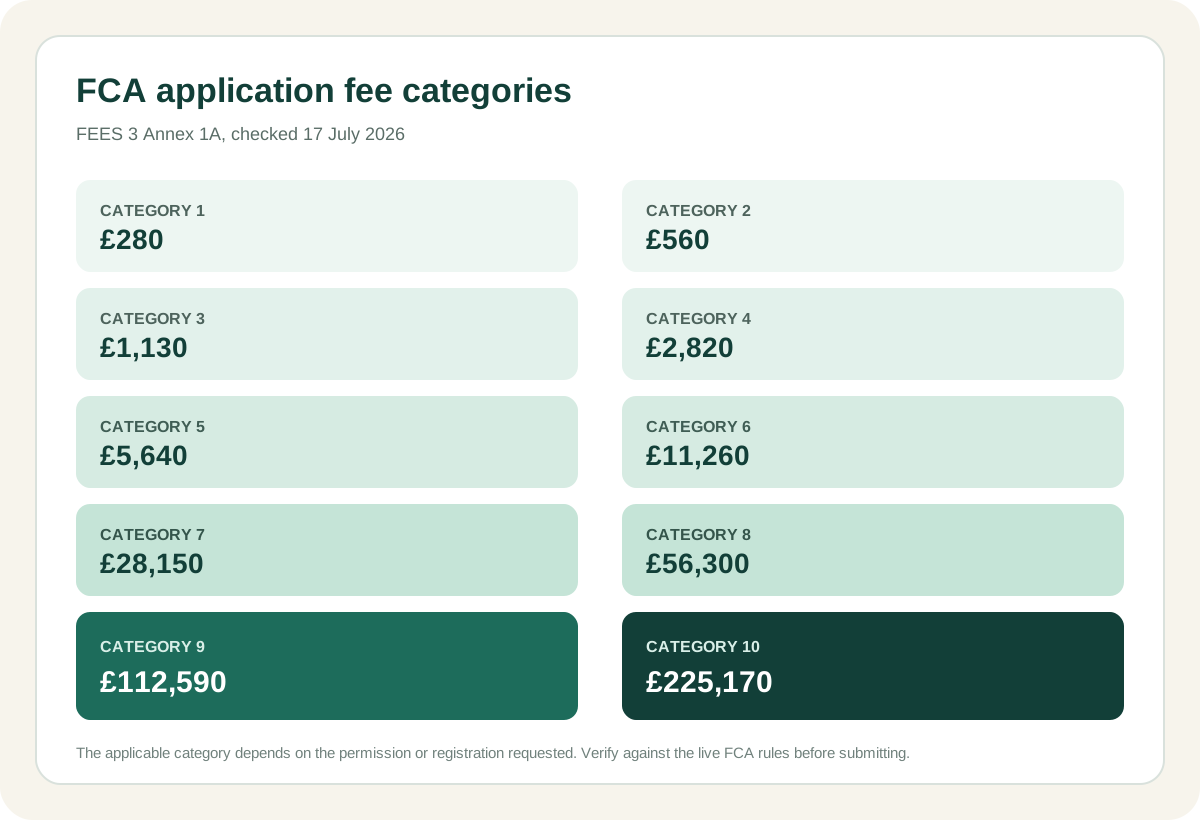
The application fee is paid through Connect when the application is submitted. The FCA states that the fee is non-refundable. There is a narrow distinction where a submission is rejected before assessment because minimum information is missing: the FCA says it will explain the rejection and refund the fee. A withdrawal after assessment has begun, or a refusal, does not normally produce a refund.
What common firms are likely to pay
The fee category follows the permission being requested. These examples come from the FCA's current public guidance and are useful for initial budgeting, but the underlying FEES rules should determine the final amount.
| Applicant type | Likely category | Current fee |
|---|---|---|
| Limited-permission consumer credit firm | Category 2 | £560 |
| Most financial advisers, mortgage brokers and general insurance intermediaries | Category 4 | £2,820 |
| Small payment institution or small electronic money institution | Category 3 | £1,130 |
| Authorised payment institution | Category 4 or 5, depending on activities | £2,820 or £5,640 |
| Authorised electronic money institution | Category 5 | £5,640 |
| Cryptoasset registration | Category 6 | £11,260 |
| Bank or insurance company jointly regulated by the FCA and PRA | Category 7 | £28,150 |
| Multilateral or organised trading facility | Category 8 | £56,300 |
Full-permission consumer credit applications can fall into Category 3, 5 or 6 depending on whether the FCA classifies the permission set as straightforward, moderately complex or complex. Claims-management, wholesale-market and fund applications also have activity-specific classifications. If several charges could apply, do not assume the lowest one.
Our FCA Fee Calculator can help identify the likely category, but it should be used as an initial estimate. If you are not yet sure how ready the business is, our free FCA authorisation readiness check shows the gaps that usually add cost and delay before you commit to a budget. The FCA's live fee page and the relevant FEES annex remain the authoritative sources.
The application fee is not the total cost
The FCA expects an applicant to be ready, willing and organised. Its authorisation guidance says documents should be final, reviewed and appropriately signed off before submission. The applicant must be able to comply with the relevant rules and meet its minimum standards on an ongoing basis.
That creates costs which vary too much by business model to reduce to one reliable market-wide total. A realistic budget should separate five components.
Regulatory scoping and application preparation. The permissions must match the activities the firm will actually conduct. The regulatory business plan, financial forecasts, governance map, programme of operations and supporting policies must tell one consistent story. Specialist advice may be useful, but its cost depends on how much work the applicant can complete credibly itself.
People and governance. The firm may need senior managers, compliance oversight, financial-crime responsibility and operational owners with sufficient competence and capacity. The cost is determined by the roles required and whether they are employed, shared or supported externally. An outsourced adviser does not transfer accountability away from the applicant's governing body or senior managers.
Financial resources. Capital or own-funds requirements vary by regime. The relevant calculation may depend on permissions, fixed overheads, client money, payment volumes or other measures. Capital is not an application fee and should not automatically be treated as spend, but it affects how much funding the firm must have available.
Systems, controls and insurance. Depending on the business, the applicant may need secure record keeping, regulatory reporting, complaints handling, monitoring, financial-crime controls, resilience arrangements and professional indemnity insurance. The design should reflect the actual customer journey and risks rather than a generic policy pack.
The assessment period and launch runway. A firm cannot carry on regulated activities while the application is under review unless an exemption or temporary permission applies. Budgeting therefore needs to cover the operating period before revenue from the regulated activity can begin.
How long the assessment can affect the budget
For a complete application, the FCA says it will usually assess a Financial Services and Markets Act firm within six months and a payments or e-money firm within three months. An incomplete application can take up to twelve months.
These are assessment periods, not promised launch dates. The FCA usually asks questions or seeks clarification. If substantive changes show that the firm was not ready when it applied, the FCA may ask it to withdraw and reapply. That is why preparation quality matters financially even though there is no reliable public basis for claiming a particular consultant-led approval rate.
When comparing a self-managed application with specialist support, ask what is included: permission mapping, drafting, financial modelling, policies, individual applications, responses to FCA questions and post-authorisation implementation. A low quote that excludes the difficult stages is not comparable with an end-to-end scope.
Ongoing FCA fees and permission changes
The application fee is a one-off charge. Once authorised, the firm pays periodic FCA fees each year. The first annual fee is normally apportioned according to the remaining months in the fee year, and the amount thereafter depends on the firm's fee blocks and tariff data.
A later variation of permission can also carry a fee. The FCA says that adding a new fee block generally costs 50% of the relevant authorisation application fee. A variation within the same fee block attracts the Category 2 charge, while reducing permissions is not charged. Regime-specific rules can differ, so check the relevant FEES provision before applying.
This is one reason to scope the initial application carefully. Applying for unnecessary activities increases complexity. Applying too narrowly can lead to a later variation, additional delay and another fee. The right answer is the smallest permission set that accurately covers the intended business, not simply the cheapest category.
A practical authorisation budget
A decision-ready budget should show the FCA application fee separately from implementation expenditure and regulatory capital. It should also state which numbers are confirmed, quoted, estimated or contingent.
Start with the intended activities and customers. Complete a regulatory perimeter assessment, map the required permissions, identify the likely fee category and then cost the operating model needed to support those permissions. Add a runway assumption based on the FCA's published assessment periods and test what happens if the application is treated as incomplete.
For a wider view of the evidence required, read our FCA authorisation preparation guide and authorisation timeline analysis.
Source position and next step
The exact category should be verified against the FCA pricing categories and the annex covering the relevant activity immediately before submission. This article is general information and is not a fee quote or legal opinion.
If you need a permission map and evidence-based application budget, our FCA authorisation service covers initial scoping through submission and regulatory follow-up. You can also book a consultation to discuss the proposed business model.
Frequently asked questions
How much does a limited-permission consumer credit application cost?
The FCA currently places limited consumer credit permission in Category 2, which is £560. Full-permission consumer credit applications can fall into Category 3, 5 or 6 depending on complexity.
Is the FCA application fee refundable?
The FCA describes the application fee as non-refundable. If the FCA rejects a submission before assessment because the minimum information is missing, its authorisation guidance says the fee will be refunded. Withdrawal or refusal after assessment does not normally result in a refund.
Does the fee include regulatory capital or professional advice?
No. The fee pays for the FCA application. Financial-resource requirements, professional advice, people, systems, insurance and implementation are separate. Their cost depends on the permissions and business model.

Need expert regulatory guidance?
Our ex-regulator team helps firms work through complex requirements and evidence compliance with confidence.